Spiraling with the Ooni
Six months with the Halo Pro mixer

Table of Contents
Over the years, I have owned at least nine stand mixers, including:
- a succession of three KitchenAid planetary mixers of various sizes
- a Viking planetary mixer
- a Nutrimill Artiste
- a Bosch Universal Mixer
- an Ankarsrum Assistent
- a Famag 10S spiral mixer
- an Ooni Halo Pro spiral mixer
Most of these have been either sold or handed off. I still have a KitchenAid 5-quart tilt-head, which I use for "abuse testing"[1] recipes and my wife uses for sweet baking. I used the Ankarsrum happily for many years, and though it's mostly gathering dust these days, I haven't been able to bring myself to part with it just yet. I bought the monster Italian Famag—its 13-liter bowl can hold between 1.5 and 10 kilos of dough—before the Trump tariffs kicked in, but it too hasn't seen much action, because it's too large for the batch sizes I'm using in Breaducation. (I have this fantasy that I might do some cottage-baking for fun once the damn thing is done, hence the emergency purchase.)
Aside from the aforementioned KitchenAid for occasional abuse testing, the only machine that I use regularly (which is nearly once a day lately) is the Ooni Halo Pro, which I got[2] soon after it launched this past spring.
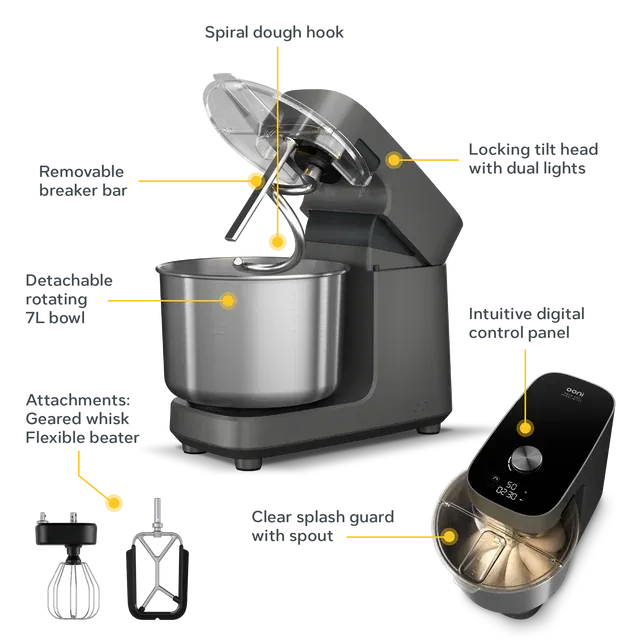
Aside from the KitchenAids (the shortcomings of which I have discussed here before) and the Viking (which sucked), all of the mixers I've used have made excellent bread, and all are great options for a home baker (except for the Famag, which is larger than most people will ever need). But after six months or so of intensive use, I think it is safe to say that the Ooni Halo Pro is the best home-baker-sized mixer for bread I've owned, and one I'd recommend wholeheartedly to anyone who bakes bread regularly and has the scratch to afford the $800 ticket price.
Spiraling
Unlike planetary mixers like a KitchenAid, spiral mixers like the Ooni Halo Pro have an offset shaft that is fixed in place, holding a hook that rotates around its own axis; the bowl also rotates, which keeps the mass of dough in continuous contact with the hook (provided the batch size is large enough, more on which below), for maximum efficiency. The Halo Pro has a powerful 650w motor set in a solid, 32-pound base, which allows it to apply lots of force to doughs without risk of the machine walking off the counter or its motor burning out, even when mixing doughs too stiff for most planetary mixers.
Planetary mixers have bowls with a rounded bottom, which gathers the mass of dough below and around the hook, limiting their capacity; if you overload one, the dough is likely to rise up around the hook and potentially crawl out of the bowl entirely. Spiral mixers, thanks to their mode of action, have wide, cylindrical bowls, which means they can handle much larger quantities of dough compared to other mixers of a similar footprint. The bowl on the Halo Pro has the same capacity as a 7-quart KitchenAid, but can mix up to 5 kilograms of dough, more than double what KitchenAid recommends putting in theirs.
As I said, I haven't used the Famag very much yet, but I've used it enough to know what to expect from a good spiral mixer. Aside from its much-smaller capacity, the Halo Pro is just as capable a machine, and I have zero complaints about its effectiveness and efficiency.
Some caveats
That said, no machine, even a great one, is perfect. There are a few things to know about the Ooni before you consider buying one; none are deal-breakers for me.
- It's LOUD. Spiral mixers have a reputation for being quiet, especially relative to planetary mixers. My Famag isn't exactly silent either, but it's quite enough that I can still carry on a conversation or hear the radio playing in the background. The Ooni, on the other hand, emits a loud and not exactly pleasant whine when in use, drowning out radios and conversations alike.
- It's not ideal for single-loaf/<1000g batches of dough, so keep that in mind if you tend to bake a loaf at a time. Ooni states the minimum dough amount as 2lb/900g, but I've found that it works most efficiently when working with dough amounts of 1000g and up, which are large enough to remain in constant contact with the hook and heavy enough to avoid climbing up it. That said, I've mixed plenty of sub-1000g doughs—some as low as 550g—but they require a little more hands-on attention (more on which below).
- I have a few very minor complaints about the user interface, which is admittedly simple and easy to use. Other than the on/off switch at the back of the unit, it only has a few user inputs. There's a large knob on the top panel for adjusting the rotation speed (from 0–100% or 0–345rpm, depending upon how you choose to display it) and mixing duration, and for starting and stopping the mixer and timer. Below it, there are two touch-sensitive switches for toggling between the mixing speed and the timer; the timer switch also serves as a toggle for the speaker, which emits a beep when the countdown timer hits zero and mixing stops.
- My main beef is with the countdown timer. You have to first set the timer to the desired mixing duration and then press the control knob to start the countdown, even when the mixer is already in motion. I'd prefer it if the countdown started automatically once the duration is set, after a short delay. Though I'm getting used to how it works, there have been more than a few instances where I've set the mix duration and walked away from the machine without starting the countdown, which is less than ideal.
- When the countdown ends and mixing ends, the timer zeros out. I'd much prefer that it displayed the length of time last selected, so I could easily recall how long the machine had been running when I return to it. (In other words, after a five-minute mix, the display would read 5:00, not 0:00.)
- Unlike other "dedicated" spiral mixers, the Halo Pro is billed as a spiral "all-purpose" machine, capable of mixing cake batters and whipping eggs, cream, and frostings. Along with the spiral hook, the Halo Pro comes with a paddle and a whipping attachment, both of which are used without the breaker bar. I've used the paddle to mix highly enriched doughs like brioche and sticky whole-rye doughs, and it works well for those. And I've used it to make pie and cracker doughs a few times, and it has done fine with those too.
- But I haven't used the Halo Pro enough with non-bread applications to say one way or another if it could truly serve as a great all-purpose mixer for the average home baker. I suspect that its large bowl capacity is a minus when it comes to other tasks like whipping cream or creaming butter and sugar. While you can overcome the issues that arise when working with small batches of bread dough, it might not be as effective in other applications without having to double or triple the typical batch size, to ensure the bowl is full enough for the machine to work efficiently.
A few tips
I have sorted out a few tricks to make sure the Halo Pro works as well as possible.
- The breaker bar can be hard to remove after use, at least without yanking on it disconcertingly hard. But there's an easy fix: periodically coat the rod end of the bar with a little oil, which allows it to slip off easily once the locknut has been disengaged.
- Doughs that are mixing in the Halo Pro—or any spiral mixer—well will display something called "pumpkining," where the dough gathers around the hook and breaker bar into a single, pleated mass at the center of the bowl, like so:
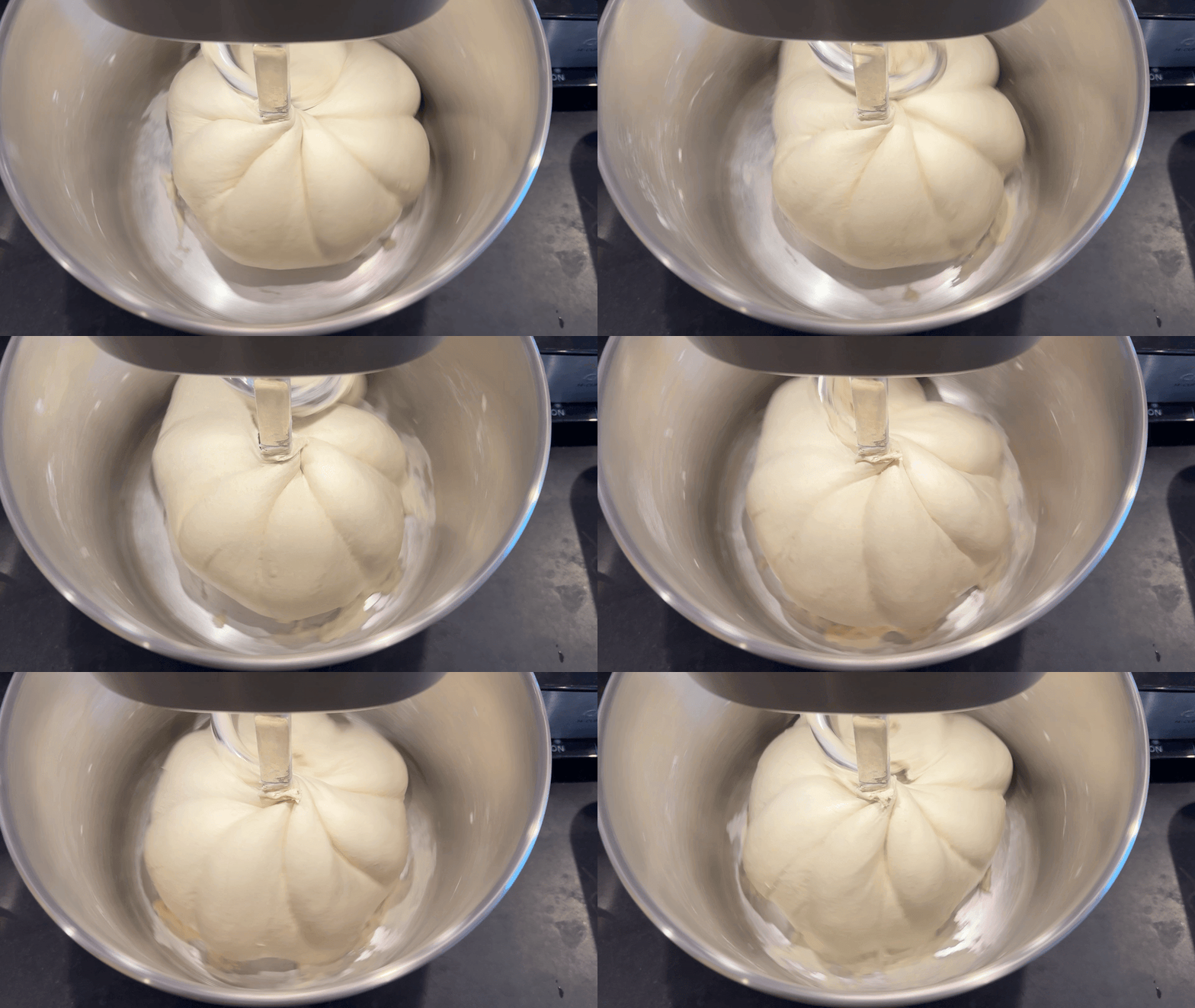
- One way it's obvious that <1000g batches of dough aren't mixing efficiently is that the dough never forms a pumpkin. To overcome this, you might have to occasionally (and carefully) stick a spatula into the front half of the mixer while it is running and use it to guide the dough toward the hook and breaker bar, so that it remains in contact with the hook as much as possible.
- Smaller batches of dough are also more likely to rise up the hook, because there isn't enough dough mass to let gravity keep it in the bottom of the bowl. If this happens, stop the machine and, using wet hands, push it off the hook completely, then continue mixing. If it does that repeatedly, it's probably a sign that the dough is strong enough and time to call it a day.
- Most bread formulas (mine included) call for just two mixing speeds, a low one used mainly for combining ingredients and hydrating the flour, and a higher one for dough development. (Speeds higher than medium on a stand mixer are mostly used for tasks other than bread making.) In Breaducation, I call these "medium-low" and "medium," and I include a table that translates those speeds into specific settings for different machines.
- On the Halo Pro, I use 35% power/135rpm for medium-low and 45% power/185rpm for medium. If I ever go above medium speed, it's only to help incorporate water or another soft ingredient like a porridge; once absorbed, I'll lower the speed back to medium and continue mixing. (When mixing wet doughs with the paddle, I'll use "medium-high," at 60–75% power.)
While the Ooni Halo Pro is not the first consumer spiral mixer priced comparably to other premium home stand mixers (that honor goes to the Wilfa Probaker, which has been available in Europe for a few years), it is the first one sold in the U.S. Its introduction is truly revolutionary, and comparable to the appearance of tabletop stone mills like the KoMo and Mockmill. With these machines, home bakers are finally gaining access to the same tools available to professionals, except on a smaller scale and an affordable price point.
Anyone else have a Halo Pro and want to share their thoughts too?
—Andrew

wordloaf Newsletter
Join the newsletter to receive the latest updates in your inbox.