Pesto Control
Two recipes, one traditional, one not
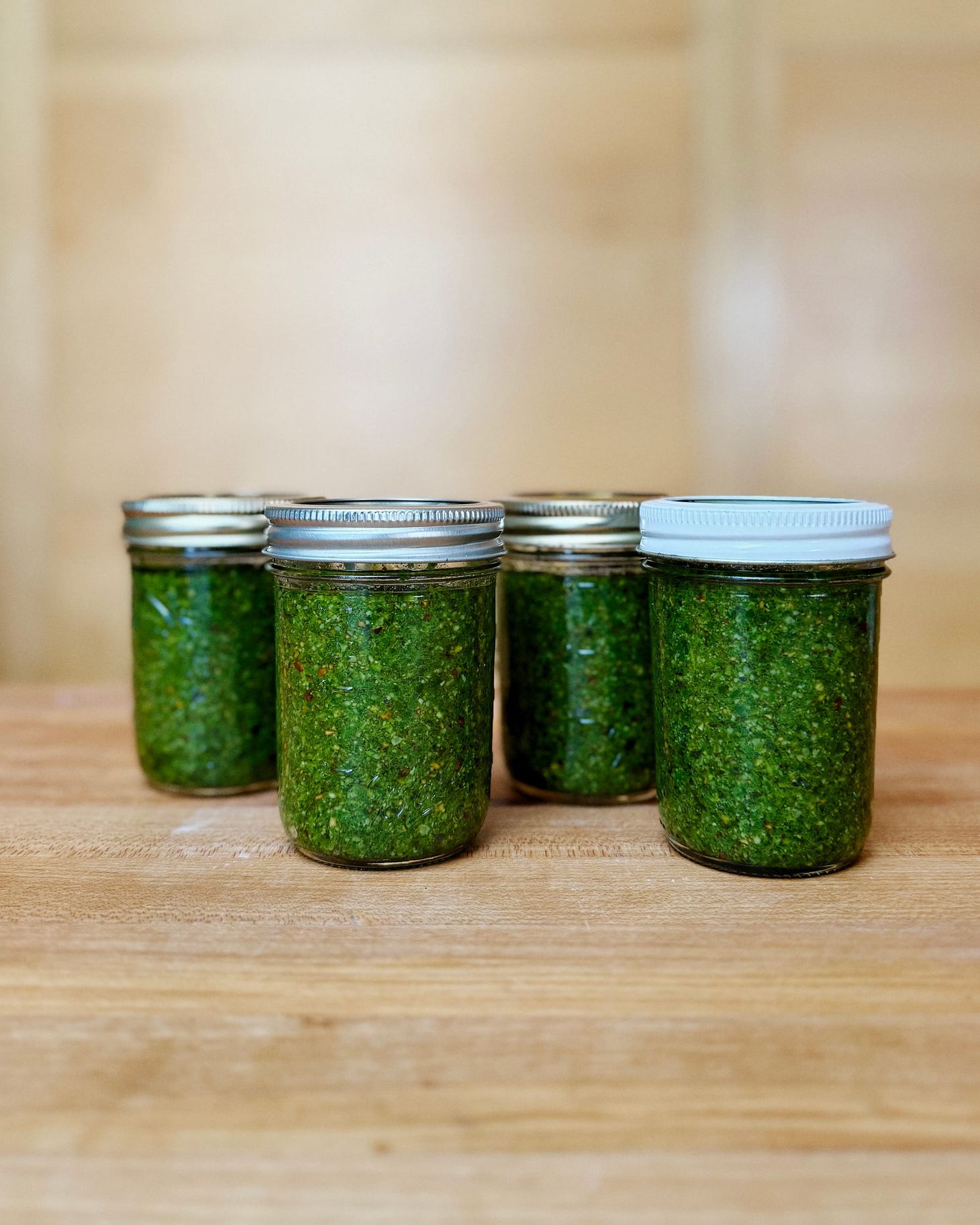
While pesto alla genovese should be served warm, it should not be cooked, so pesto is not something I use in breads. (If I ever put pesto on pizza, it goes on after baking, not before.) But I do try to have bread around when making pasta with pesto, since (more on which below) it's handy to mop up what's left in the bowl once the pasta is gone. And it makes a nice dip for bread, even in the absence of pasta. So this post is certainly bread-adjacent.
We grow basil in our city roof garden, where it goes gangbusters. I plant eight to ten plants each in three-by-two-foot self-watering planters, staggering the plantings by a month or so starting after the last frost in May, which keeps us in basil all season long. And pesto all year long, since it freezes beautifully.
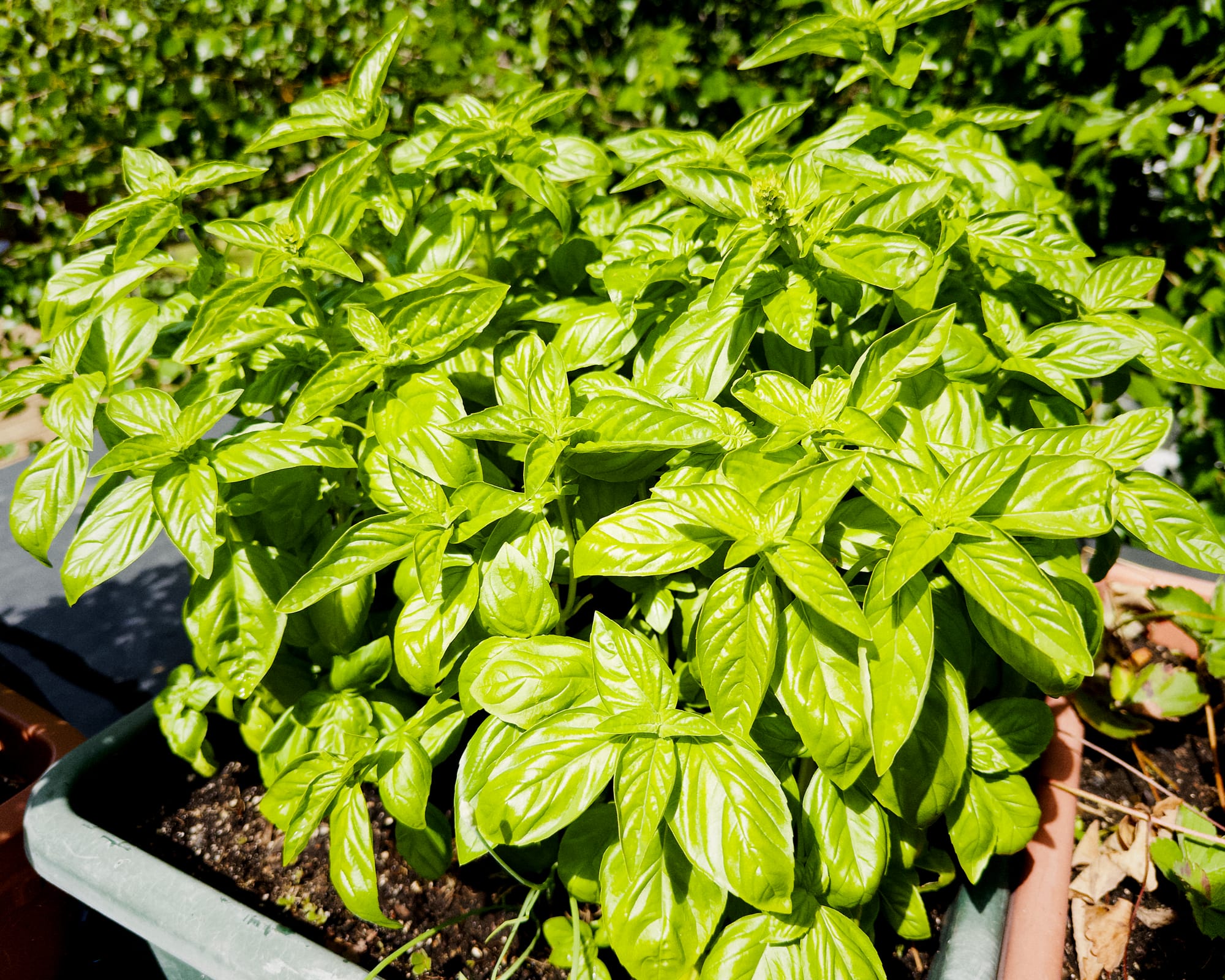
This has been our routine for more than a decade, so I've had time to perfect my pesto recipe and approach, one that captures the basil at its peak of flavor while preserving its color, even when stored in the fridge awhile. With the caveat that I'm not Italian, have never been to Liguria, pesto's home territory, and have (tragically) only been to Italy once, I think my recipe is pretty damn good. Here are the basic elements of my approach.
The basil. I try to harvest basil just as it starts to flower, which keeps the plants leafing out for a long time. I'll nip the stems a few nodes down from the top, so that they'll branch out. I'll also harvest larger leaves from the understory to let more light in between the plants, but I won't use them in the pesto unless they are bright green.
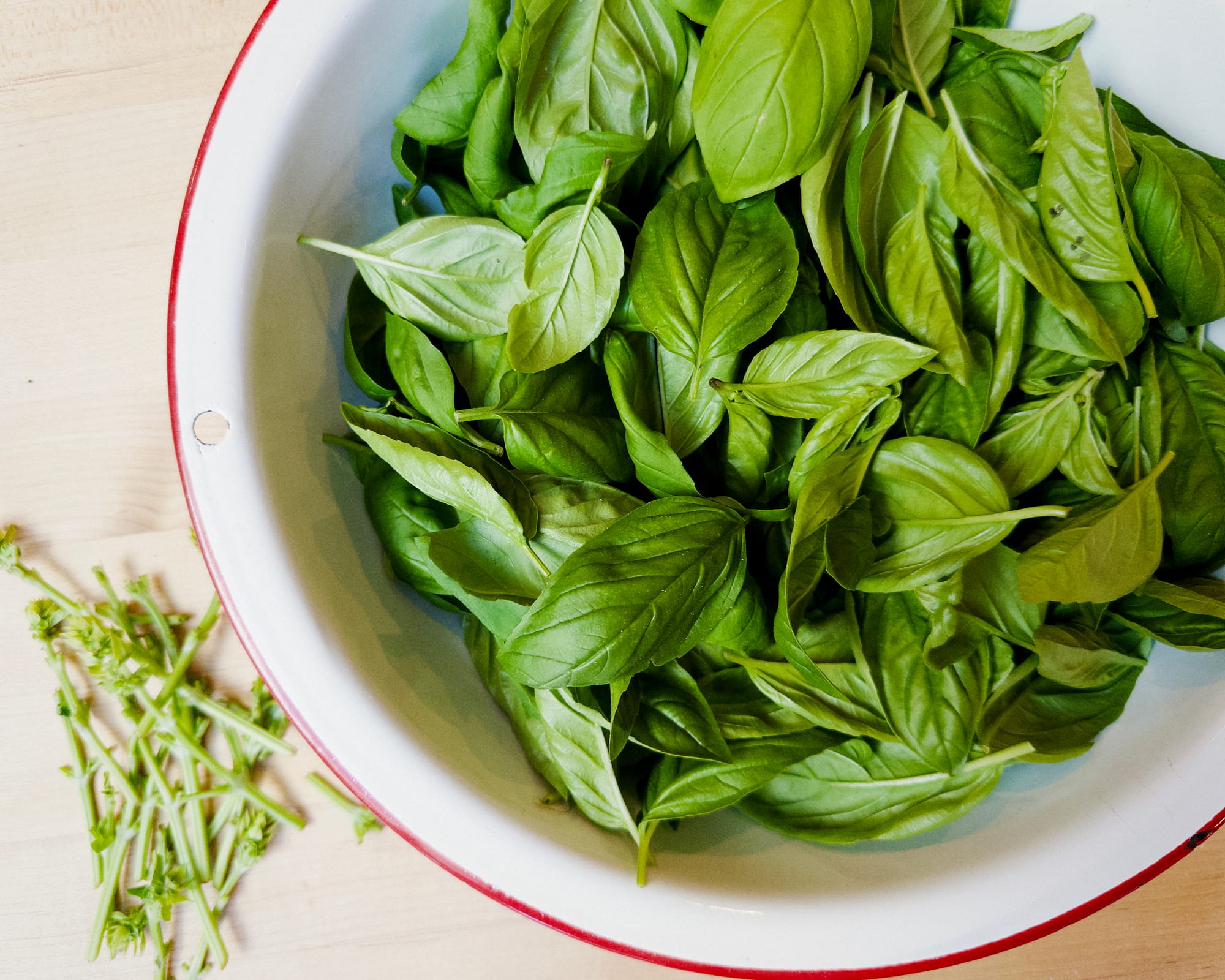
I'll then pick the leaves from the stems; if the flowers are tender and immature, I'll use them in the pesto. Ditto for any tender slips of stem from the top of the plant. Once picked, I'll weigh the harvest and scale the pesto recipe appropriately. I try to keep the ratio of ingredients tight, but if the amount of basil is not a perfect round 100g amount, I'll fudge it a little, erring on the side of more basil and less everything else.
Blanching. Blanching the basil first is not absolutely necessary, but only if you are going to eat the pesto straightaway. Otherwise, it will turn brown or black quickly in storage, even when covered in oil; blanching preserves its bright green color. Contrary to basil-blanching naysayers, the aromatics in basil are not water-soluble, so the practice does not diminish its flavor appreciably; more importantly, it prevents the basil from oxidizing in storage, which definitely does diminish its flavor. It also cleans the leaves of debris and the occasional bug, eliminating the need to wash them separately.
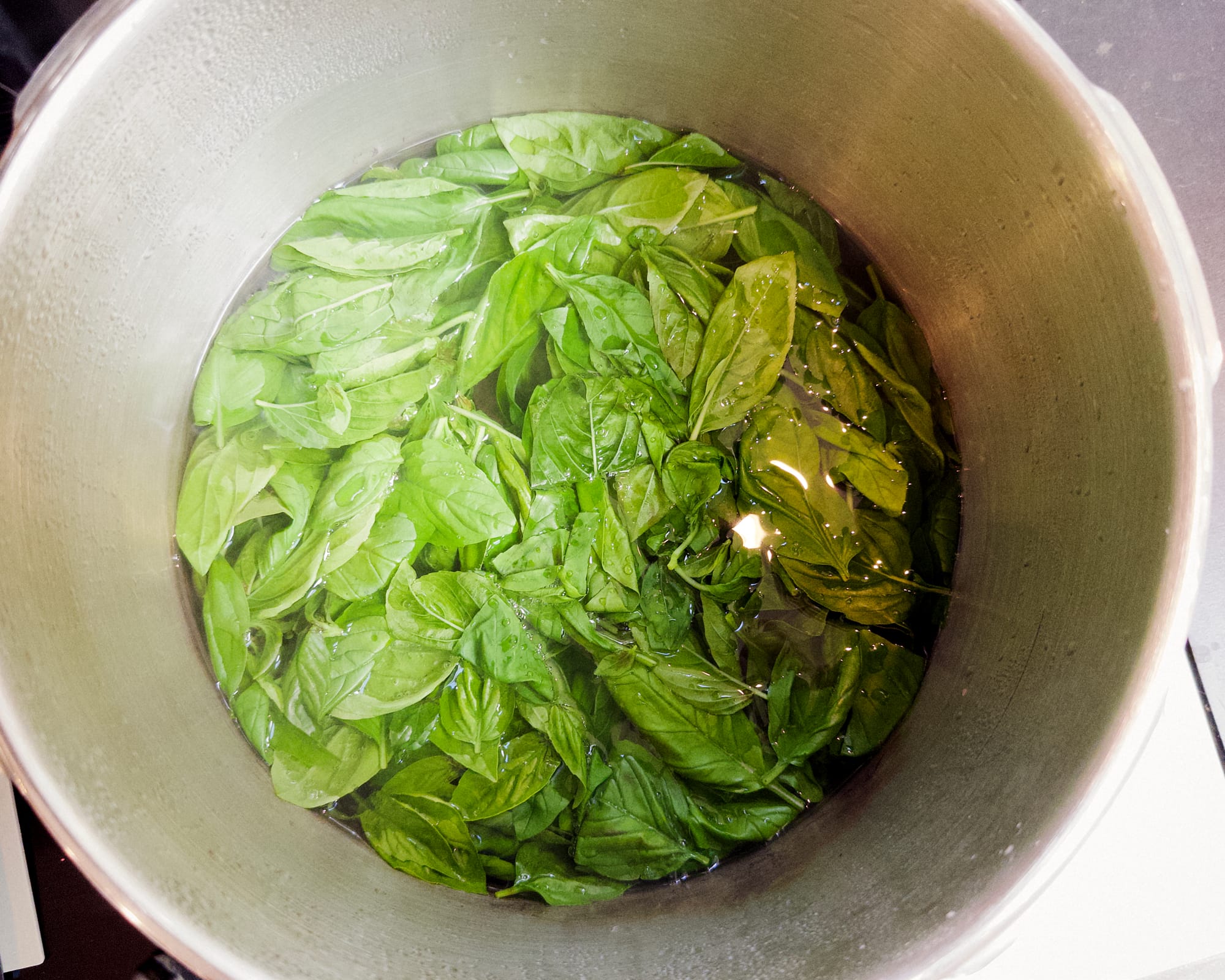
It's quick and easy to do: After picking (and weighing) the leaves, I'll bring a Dutch oven of water and a teaspoon of salt or so to a boil. I'll add as many leaves as will fit comfortably and stir them around until they wilt uniformly, which takes less than a minute. Then I'll use a skimmer to transfer them to a bowl of cold water (ice is not at all necessary here, as long as you bring them down to room temperature quickly). I'll repeat if I have more leaves to process, then I'll drain everything and spin them as dry as possible in a salad spinner. (I don't dry them more than this—pesto has water in it, so they don't need to be bone dry.)
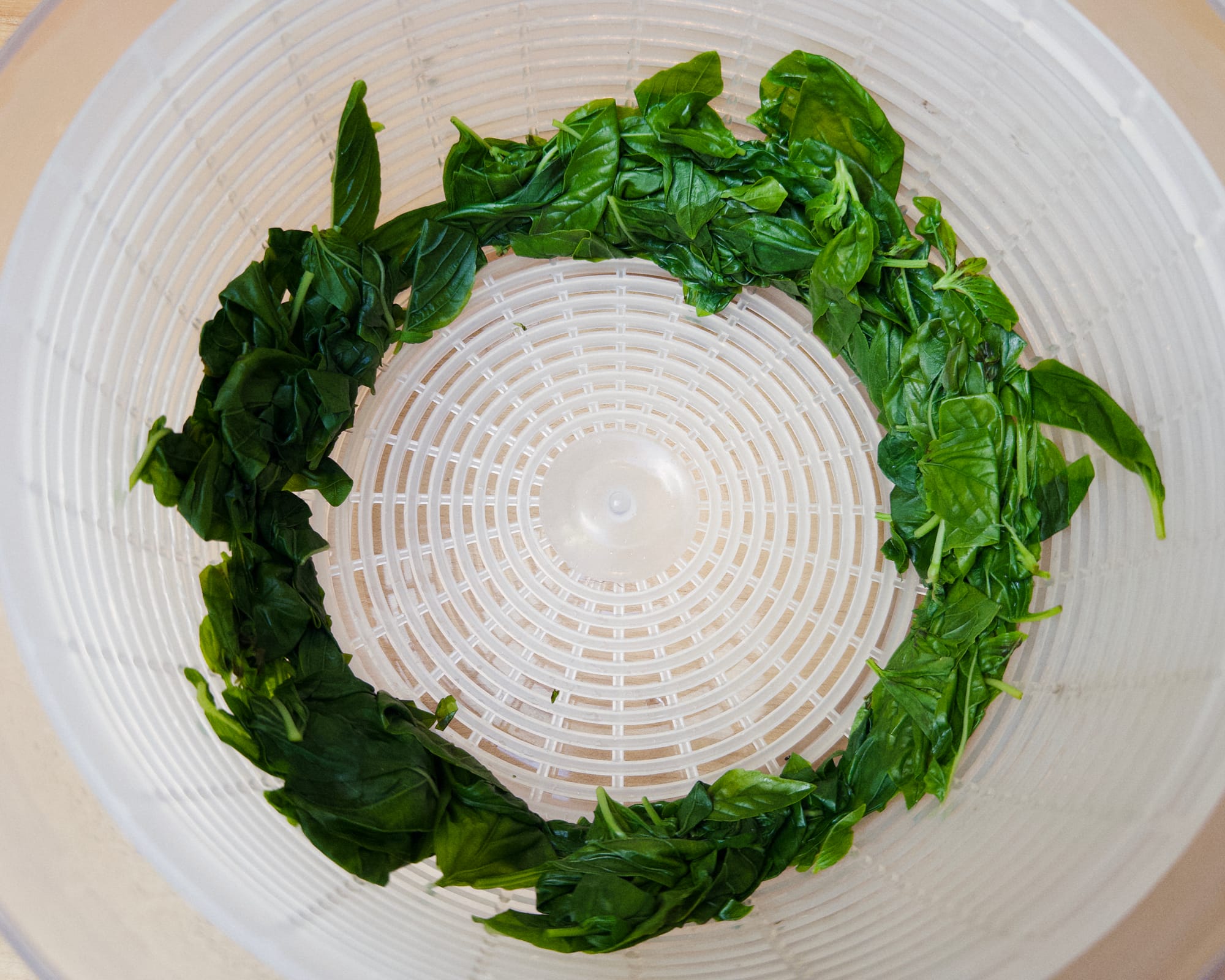
At this point, you can store the blanched leaves in a sealed container the fridge for a few days without risk of wilting or browning, which is nice if you have a lot of basil to hold before processing (and way better than storing fresh basil in the fridge, where it can quickly wither and blacken).
Nuts. Yes, pesto should be made with pine nuts, but a) they are expensive, and b) pine nut mouth, so I don't use them often myself. Other nuts work just as well, and I tend to use whatever I have on hand, usually pecans or walnuts, but also cashews, almonds, pistachios, hazelnuts, and—in the case of my Thai basil pesto, see below—roasted peanuts. I use a modest amount of nuts to basil—a 1:3 ratio by weight; I don't toast them first, as it doesn't seem to affect the texture one way or the other.
Food processor. I'm sure that making pesto in a mortar and pestle gives a superior result, but who has time for that? Mortaring and pestling it will do a far better job of emulsifying the sauce, but it's not necessary IMO since that can happen just before serving it (more on which below).
I don't just dump everything in the processor at once, though; instead, I chop the nuts and garlic separately, which keeps the nuts from blending to a paste, giving something closer to what you might get in a mortar. I then set them aside and then process the basil and oil until it just begins to yield its color to the oil, a sign the leaves have broken down sufficiently, but not so much that the pesto is a smooth purée or long enough to oxidize the oil and produce bitterness. Then I just pulse in the nut-garlic mixture and cheese.
The cheese. Traditionally, pesto alla genovese is made with Parmigiano Reggiano or Pecorino Fiore Sardo, or a combination of the two. The latter is a sheep milk cheese like Pecorino Romano, but far less salty. It's also pretty hard to find. I tend to simply use Parmigiano Reggiano, or a mixture of Parmesan and Pecorino Romano, leaning slightly more heavily to the former. I don't use a lot of cheese in the pesto, preferring to add more at serving, since its flavor diminishes a little in the freezer.
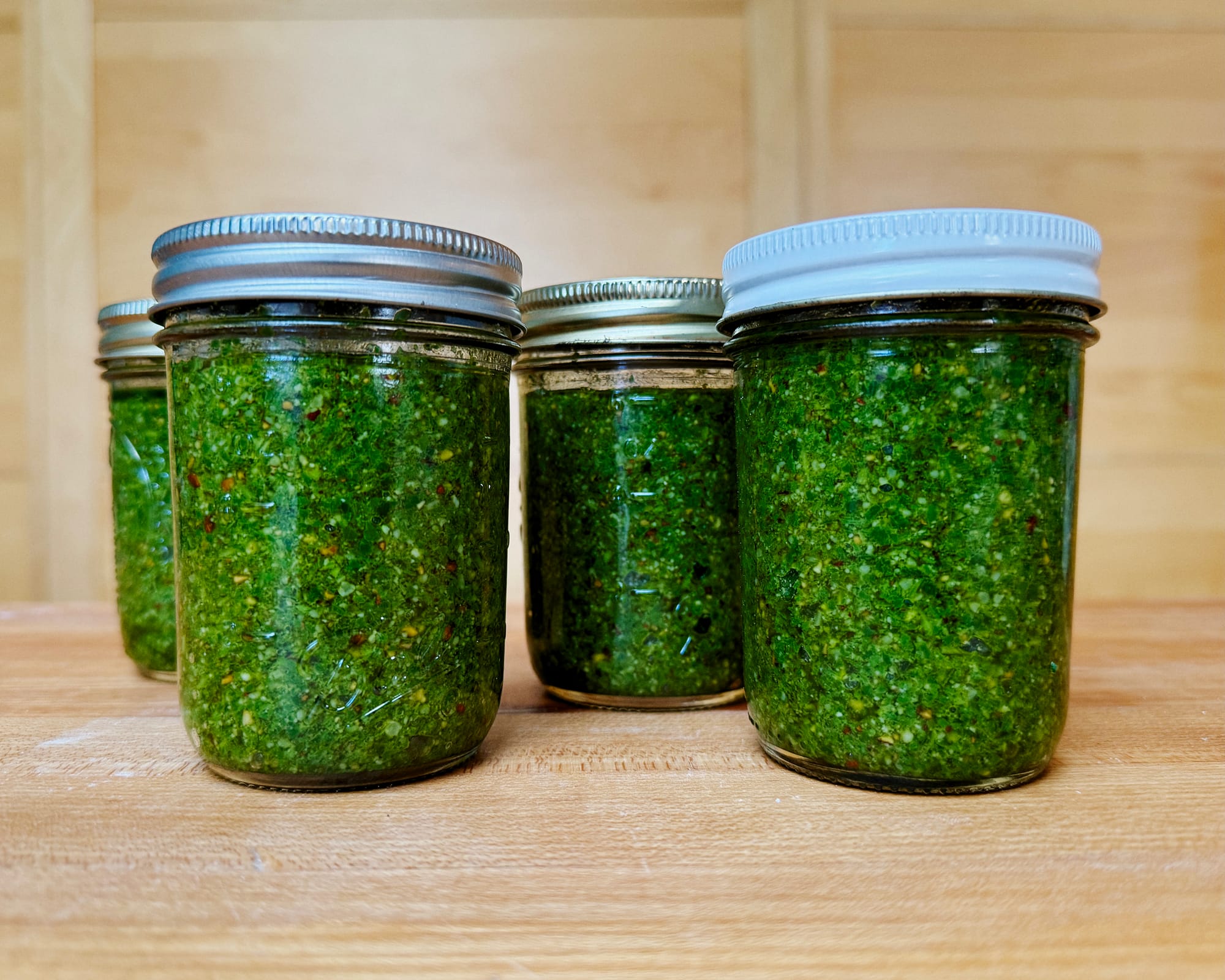
Storage. I store my pesto in tightly-sealed half-pint mason jars, which when filled nearly completely, hold just enough pesto for a pound of (dry) pasta, to serve four. That minimizes the amount of oil needed to cap the pesto, and allows me to use it up an entire jar soon after it comes out of the freezer.
Finishing. At least when it is used on pasta, the process of making pesto is not complete until it has been thinned out and emulsified with starchy pasta water—it's a sauce, not a spread. It can take a bit of practice to know how much pasta water to use—you don't want it to be watery—but the goal is to have it remain saucy on the plate, even after it sits a few minutes, such that by once the bowl is empty, it can still be mopped up with a piece of bread.
I'll cook the pasta until al dente, scoop a cup or two of pasta water into a measuring cup, then drain the pasta. I'll then add the pesto the empty pot and set it over very gentle heat, thinning it out slowly with pasta water, stirring constantly with a spatula; the goal here is to warm it up and emulsify it, not cook it. I'll then take it off the heat, add the pasta, stir it up, adding more pasta water as needed to keep it saucy by the time it gets to the plate.
If I'm using the pesto as a dip for bread or a topping for pizza, I'll let it come to room temperature and thin it out with more olive oil to a loose consistency, or if I'm being extra-fancy, with some ersatz pasta water made by cooking a few teaspoons of flour into a half-cup of water.
Bonus: Thai basil pesto
When we grow or purchase Thai basil from the farmers market, I also make an Asian-ish pesto with roasted peanuts, extra garlic, green chiles, toasted sesame oil, and fish sauce (or tamari, now that I am a vegetarian), which is excellent served over a variety of noodles. (It's nearly as nice if less distinctively Asian when made entirely with Italian basil.) Wordloaf paid subscribers can find the recipe below.
—Andrew
Pesto alla genovese
Makes 2 half-pint jars (each one to serve 4)
- You can skip grating the cheeses and instead process them fine in the food processor before you begin making the pesto. Remove it from the processor and set aside until the end of step 3.
100g (5 cups) basil leaves and tender stems and flowers
32g (1/4 cup) pine nuts, walnuts, pecans, pistachios, hazelnuts, cashews, or almonds
4g (1 medium clove) garlic
2g (scant 1/2 teaspoon fine) salt
112g (1/2 cup) extra-virgin olive oil
37g (2/3 cup) rasp-grated Parmigiano Reggiano, Pecorino Fiore Sardo, Pecorino Romano, or a mixture
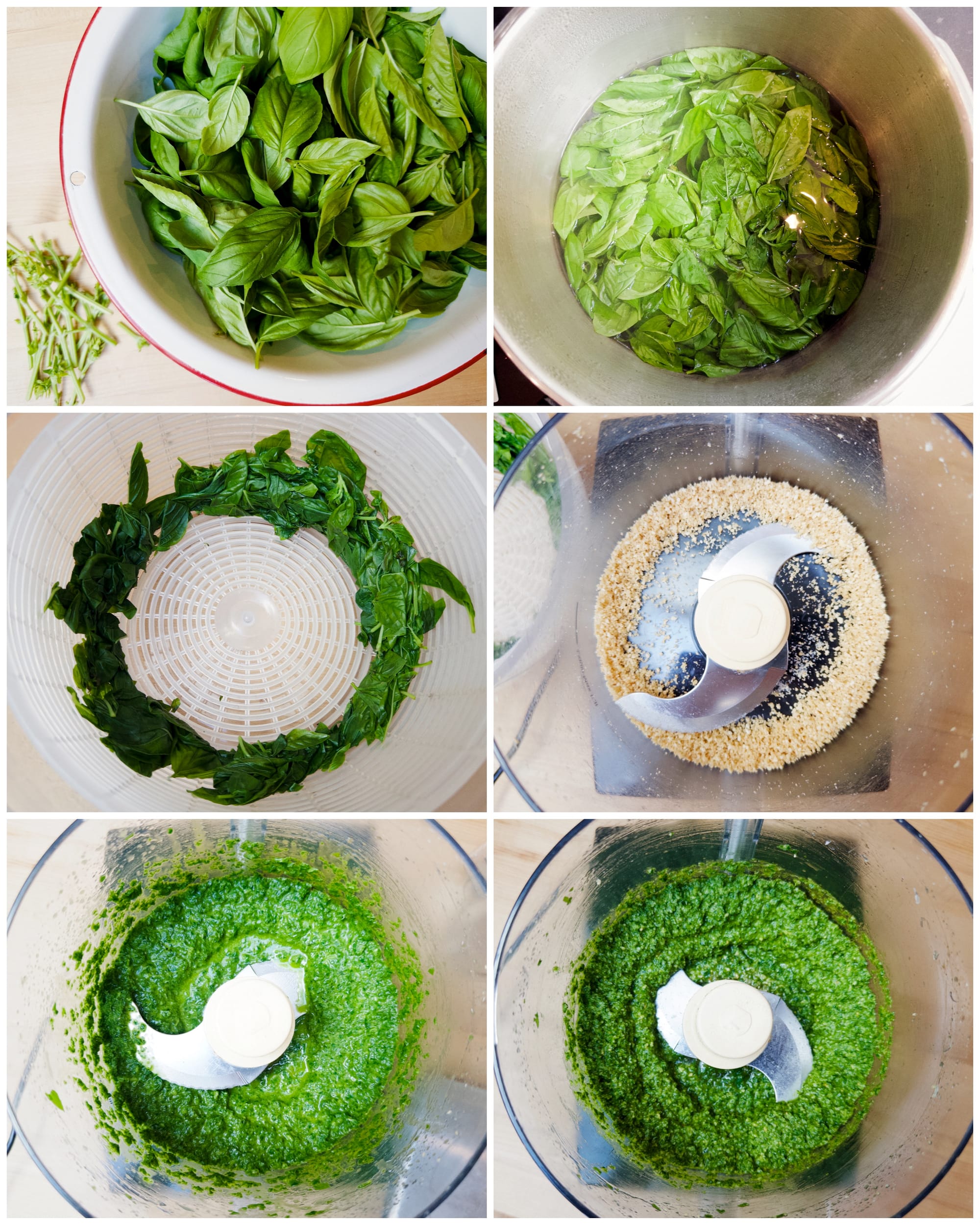
- Blanch the basil in lightly-salted boiling water, about 30 seconds. Dunk in cool water, then dry as thoroughly as possible in a salad spinner.
- Place the nuts, garlic, and salt in the bowl of a food processor and process until finely chopped, about 30 seconds. Transfer to a small bowl.
- Add the basil and process until chopped very fine, 30 to 60 seconds, scraping down the sides of the bowl as needed. With the machine running, add the oil in a thin stream; once fully added, process until the mixture is pale in color and emulsified, about 30 seconds. Return the nut mixture to the processor and pulse until just combined. Add the cheese and pulse until uniform.
- Transfer to 1/2 pint jars, level, and cover with a thin layer of oil. Cover tightly and refrigerate for up to 5 days, or freeze for up to 6 months.
Thai basil pesto
Makes 2 half-pint jars (each one to serve 4)
This content is for Paid Members
Unlock full access to wordloaf and see the entire library of members-only content.
SubscribeAlready have an account? Log in