On Bread
an excerpt from Alicia Kennedy's new book, "On Eating"
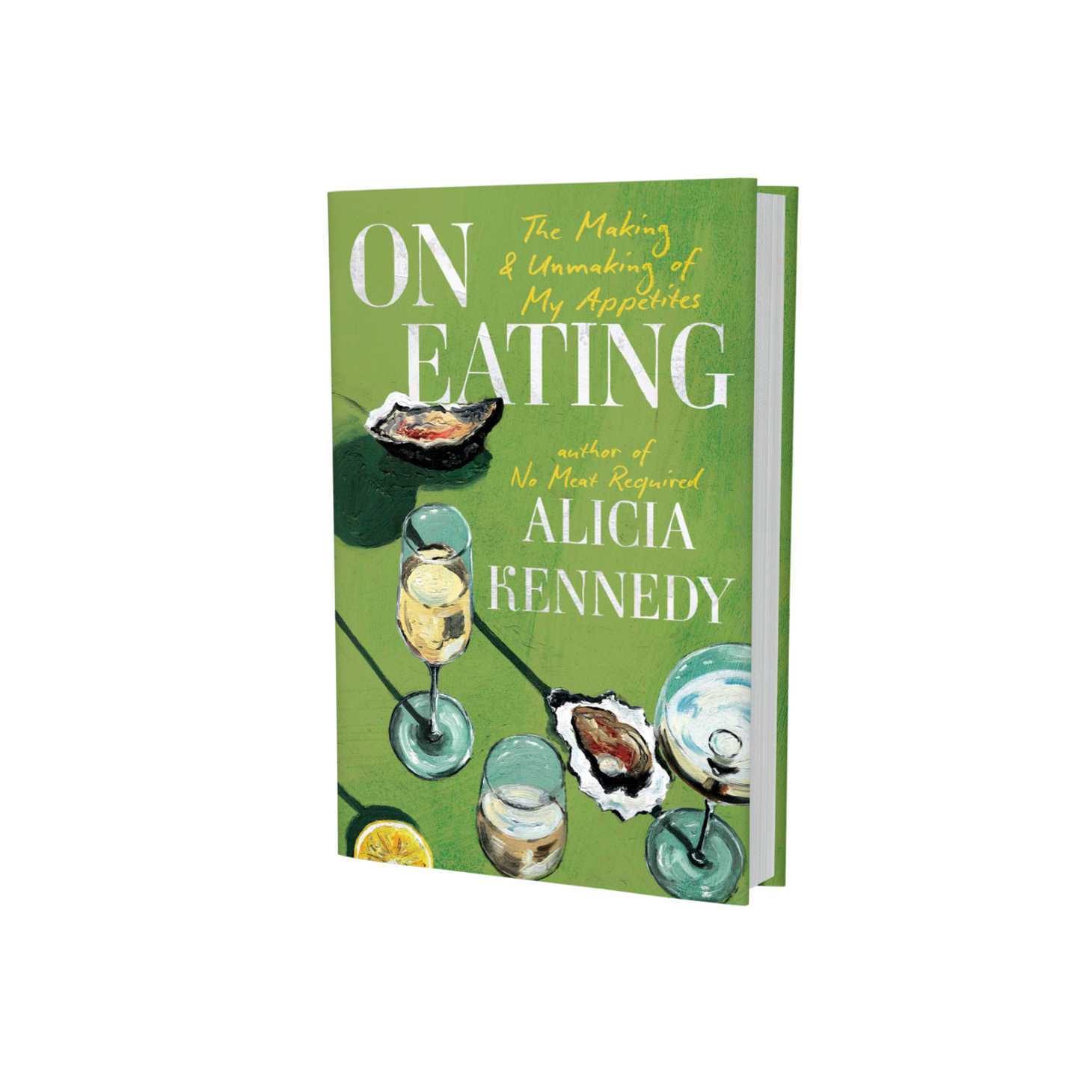
Table of Contents
Alicia Kennedy and I sort of came up at the same time in the modern world of food newsletters; Wordloaf and her From the Desk of Alicia Kennedy both launched in 2020. She and I compared notes about news lettering early on, and we've been friends since. In the interim, From the Desk has expanded into a small-but-mighty food media hub and has even spawned an online magazine, Tomato Tomato, with contributions from many other wonderful writers. She's also somehow managed to write two whole books during that time: 2023's No Meat Required—on the history and politics of eating meat or not in our modern world—and this year's On Eating: The Making and Unmaking of My Appetites. Full confession: I have yet to read No Meat Required, despite having been a vegetarian for the last five years or so; it came out while I was deep in work on my own book, so it has remained on the to-be-read stack by my bedside ever since. But I have read On Eating, and it's wonderful.
If you are familiar with Alicia's work from her newsletter or elsewhere, you might expect a book from her on eating, food, and appetite to be polemical. Though it naturally contains strong opinions, they are threaded here within a deeply personal story about her own relationship to food, cooking, and place. And about how who she is as a person is inextricably linked to the foods she has (or has not) eaten and cooked along the way. (I'm not sure I've read a food memoir quite like On Eating before, but M.F.K. Fisher's The Gastronomical Me comes to mind, at least structurally.)
It's the story of her life, told through a series of fourteen chapters, twelve of which focused on one particular food or ingredient. Each food serves a lens through which Alicia looks back upon her life; her encounters with many of them were also central pivot points along the path to the present, each propelling her forward into a new understanding of herself, her work, and her place in the world. It's a thoughtful, heartfelt, and beautifully-written book, and one that I think most Wordloaf readers will want to own.
Alicia has generously offered to let me share a long excerpt from On Eating with you all, from the chapter "On Bread."
—Andrew
On Bread
(excerpted from Alicia Kennedy's On Eating)
There is a moment in the making of any dough when one is reminded of every other dough they've ever kneaded. A flour tortilla rolled out so thin it's almost translucent feels like the shell of a pastelillo or dumpling. A flatbread in process can feel, for a second, like focaccia. The difference between pizza and pita is a level of hydration. Ask a serious bread baker about this and perhaps they'll write me off as an amateur before listing all the nuanced distinctions between these, but if you make breads from scratch, you know: We all feed our similar craving for the softness and satisfaction that flour milled from wheat can provide in different ways, with different stuffings. Every dough begets knowledge that we bring to the next, learning what flour and water are telling us in all their ratios, origins, and iterations.
The only bread I saw as a kid was the fluffy white Wonder Bread I would never eat, and loaves of sesame-seeded Italian bread that we ate when we had pasta for dinner. If we hadn't sliced it before putting it in a basket, my parents would rip pieces from it and throw them to each other from either end of the dining room table; whether the throws were lobbed and easy or hard and pointed-this told us the mood they were in for our meal, how fast we should eat our spaghetti.
But I can pinpoint when I first ate bread I liked, bread that made me say, I get it. It was from Waldbaum's, the supermarket that was down the block, and it was in a plastic bag with a sticker that read, "Peasant Bread." It was perfectly round and uniformly caramel brown. We sliced it into thin pieces, and it had the taste of yeast. This wasn't good bread, not like we know hearty loaves of fresh sourdough to be now, with their airy crumbs and elegant chew. From my suburban perspective, though, it was finally something decent. It was the equivalent type of experience to when I first tasted Dijon when I'd thought bright yellow French's was all there was to mustard: I get it now. I never let myself long for my grandma, but these memories tell me what I might have wanted to talk to her about. Good bread. Good mustard. What else?
It was easy for me to give up meat for animals, the planet, biodiversity. What I have struggled with adapting to is the potential future where flour milled from the grain known as wheat is more scarce. I once bought a cup of finely ground flour made from batata, a sweet potato, and failed to make edible crackers. The jar cost twenty dollars. This doesn't allow a lot of room for experimentation. There are traditions of making hearty items with the flours of breadfruit or cassava; I read about how they're making ham-like deli meat out of cassava flour in Cuba, to compensate for meat's scarcity. I see a friend in Colombia, visiting, post a pan de yuca that resembles a sourdough and this intrigues me—I'll have to learn what they're doing. I'll have to go to Bogotá, I say to myself, when I can afford it.
I find myself aligned with the ranchers and dairy farmers I dislike in this case, the ones who say "that's not meat," "that's not milk" about plant-based products. My internal monologue insists, That's not bread. I find that the people who find the most beauty in this potential, who are most enamored of so-called "alternative grains" other than wheat that don't have its high level of easy-working gluten protein, tend to be those who live in temperate climates and wouldn't have to live without such flours, without the snappy crust and airy satisfaction of a good baguette. There are also, of course, those with celiac disease, for whom alternative grains and flours have been a godsend. My desperation isn't about my livelihood, my health, or my identity, the way it is for the ranchers and dairy farmers: It's about fear of what it would mean if wheat were no longer shipped to Puerto Rico, as flour or to be milled. It's also a deeply internalized attachment to Eurocentric gastronomy. One is a problem of potential disaster and scarcity; the other, an issue of imagination that can be easily if not enthusiastically solved.
I had vague notions about ancient grains, like the ones used to make the Ezekiel breads I bought frozen and toasted for breakfast, spread with almond butter. I added spelt to muffins; I played around with amaranth for its crunch; I tried out rye in a chocolate-chip cookie, when that was trendy. Like any baker, I had a moment with buckwheat, often grown as a cover crop that keeps weeds and insects away. I was focused more on making sure everything was vegan and tasted good, as well as on using fair-trade sugar, chocolate, and coconut milk and oil. These were where I was most sure of exploitation in the chain, of humans and animals. Using local flour was a no-brainer, but it also was so easy to do in New York. It didn't feel as special as I now know it to be. It was only in 2009, just four years before I began my bakery project, that Farmer Ground Flour in upstate New York was founded and started to source and mill organic grains grown in the state, including wheat. Though New York isn't an ideal ecosystem for wheat owing to its humid summers, with crop rotation and diverse use of the soil, the movement was the start of an understanding that grains can be a locally sourced food. Historically, because grains can store well, the harvest was something a people could come together for; now, there are farmers who grow everything from rye and corn to oats and buckwheat. Soft wheat for pastry and hard wheat for bread. There's so much grain to grow—why should we stick to one?
"The relative stability of grains, which since ancient times has made them a good food to store," writes Amy Halloran in The New Bread Basket, "is the same thing that has allowed this staple to become a commodity, vanishing into the anonymous middle of the country." Grain farmers, millers, bakers, and even folks who are making beer or whiskey have had to make enormous efforts to make grains something that don't fade into the background but are at the forefront of the palate. The very fact that flour doesn't have to disappear, that the white powder we understand as a pantry staple could have a grander expression, continues to be a revelation.
Wheat can only withstand temperatures up to seventy-five degrees Fahrenheit. Increased heat and drought, or increased rain—these will compromise production, for the reason they compromise production of many temperate crops: They can only sustain life to a certain point, and pests will thrive upon them in wetter conditions. Wheat, like soy, has a lot of power as a global commodity. Without it, or when it's too expensive, it will be a domino to fall toward calamity. People rely on it for 20 percent of daily calories. Diversifying this dependence, as painful and depressing as it might be in a world where were accustomed to the crisp crust of a well-made sourdough loaf and a specific fluffy texture in our birthday cakes, is quite obviously a necessity.
Despite this more fashionable recent interest in bread as special, something to appreciate and spend ten dollars on regularly, bread has historically had a connotation of being a basic necessity, an essential means of sustenance, unromantic. It's a way of saying, "I'm for the people," whether that's true or not. Demands for bread are thus part of a salt-of-the-earth vision; bread is about inclusion, feeding everyone. Bread, quite clearly, is not steak. Necessity, not luxury.
In The Conquest of Bread, written in 1892, Russian anarchist Peter Kropotkin writes that would-be revolutionaries were too concerned with the high-level questions of what the best way to govern would be rather than how to provide food for the working people. "They discussed various political questions at great length, but forgot to discuss the question of bread," he writes.
Like so many other foods before it, bread has been made over to be "fancy," despite itself, and a subject of mastery and expertise rather than a means of creating food and experiencing the joy of said creation. I make breads—leavened and unleavened— on a regular basis, throughout the week, because I know that to feel full and happy, I need my cabbage salad with a hard-boiled egg snugly wrapped in a flatbread and my summer tomatoes with basil and mozzarella on focaccia, tasting of fragrant olive oil. Now that I'm accustomed to rolling out flour tortillas myself, I can't be bothered with the rubbery ones from the supermarket, and they're the perfect complement to seared mushrooms I've dry-seasoned with adobo powder, smoked paprika, and chili, or black beans spiced with chipotle peppers.
I don't have a sourdough starter because it requires attention that I know, because I've tried, would be antithetical to me actually using it. While I'm good at pantry prepping and meal planning, the ease of having yeast in the freezer to give rise to my breads makes more sense for the flow of my days. I used to be ashamed of this, thinking it made me less of a home cook and less of a food writer. Now, I think, who cares? The best way to do things in the kitchen is the way that enables you to actually cook. I don't need to bake beautiful three-day-process sourdough loaves. I need to eat what I feel like eating.
This doesn't mean baguettes and sourdough loaves aren't on rotation in my kitchen—quite the contrary. (I have one real rule for life, and it's always have a baguette in the freezer for emergencies.) I've taken to heart the way that baker Rick Easton of Bread & Salt in New Jersey discusses the role of bread bakers in community: When there's a good bread baker around, like my friend Diego San Miguel, support them. It's better to put the money into someone who has the right equipment, the know-how, the hours put in, the access to the best ingredients, rather than seek expertise at home and usually find frustration. Of course, this won't apply to everyone who likes to bake sourdough at home. It does apply to me, who does not.
Living in the tropics makes it obvious that it's better to just pay the bakers. I don't have central air conditioning to control growth and humidity, not to mention my own comfort. For the same reason I'm not baking cookies in July, I'm not baking sourdough bread at any point in the year when the humidity might leap or drop and change everything about the dough I'm dealing with. I do get a few good days in January, always, when it's time to bake the cookies, when I can do it without cursing because they're falling limp, because they won't stay chilled long enough to form into balls or allow me to cut them into shapes.
I could blame my oven for my lack of home sourdough enthusiasm, which is small and runs on propane gas tanks, but I'm always putting things in the oven, no matter the time of year. People in temperate climates don't seem to understand this. I might not have been able to understand it before I lived it. It's very difficult to intellectually understand relentless heat that only becomes more hot: The relief of winter is not in the lowering of temperatures, but in the reprieve from humidity, a few weeks when the sun simply feels less sharp on the shoulders. When people tell me it's too hot to turn on the oven for the three to four months of their northeastern U.S. summer, I want to know what it would be like to say that from March through October, through November. What would change about me to keep me from my flatbread in August, my focaccia in the thick of hurricane season, my tacos during another day in a week of extreme heat advisories? What normalcy would I be willing to sacrifice to let the heat win? What normalcy will I have to sacrifice eventually?
Excerpted with permission from On Eating: The Making and Unmaking of My Appetites, by Alicia Kennedy, published by Hachette Book Group, 2026.
wordloaf Newsletter
Join the newsletter to receive the latest updates in your inbox.