Finally
(I finished it)
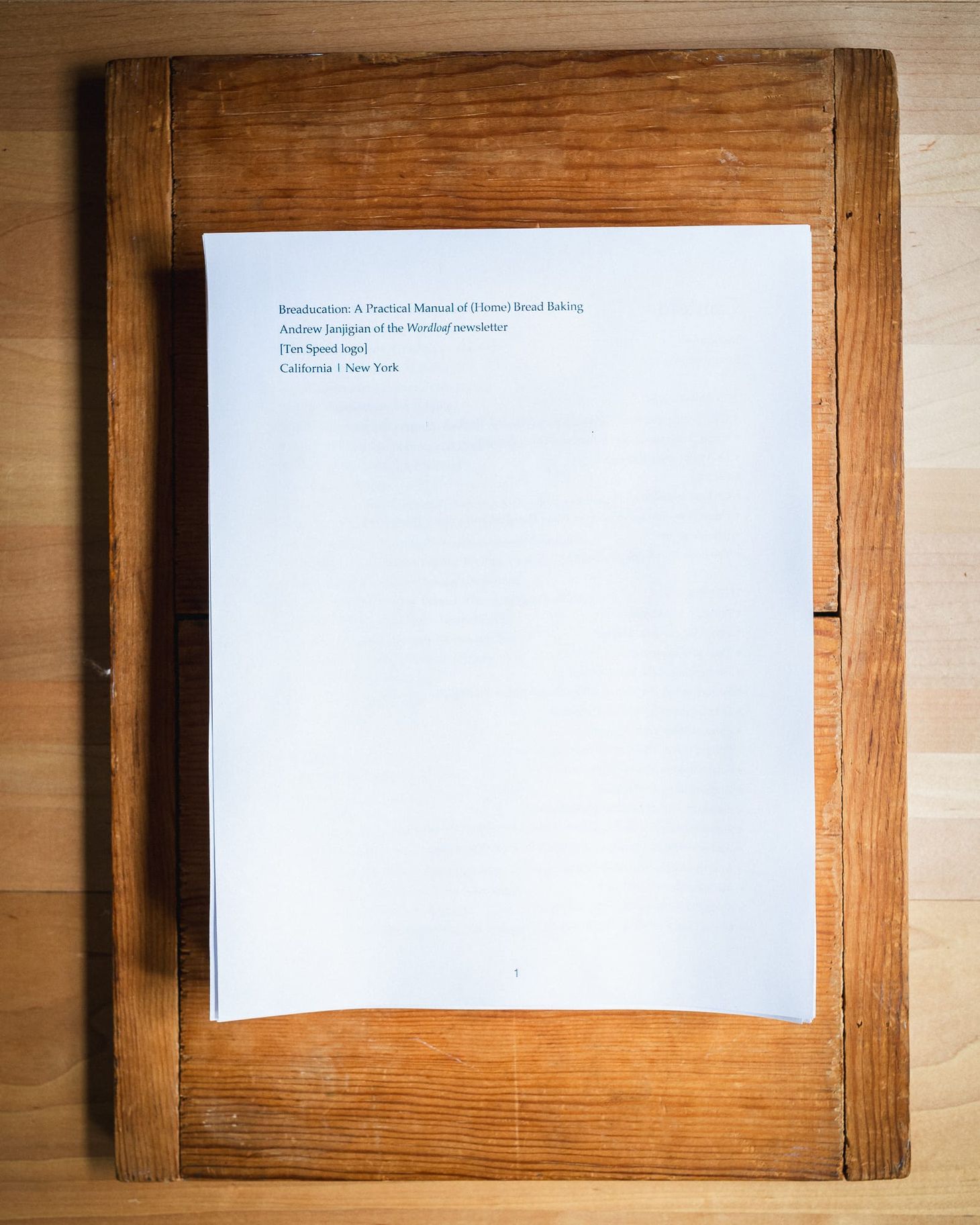
Table of Contents
It's not done done, since there are still photographs and illustrations to create, recipes to button up and cross-test, and yet more rounds of edits, but after 2 years and 10 months, I've finally finished the manuscript for Breaducation. I've written 6 or 7 drafts of it by now, a couple that were "complete," but this is the first time that the entirety of the book, from title page to "about the author" page, is on paper. The intro is written, the front matter complete, the recipes in place and spelled out in full, the glossary written and alphabetized, etc. From here on in, only corrections, deletions, and minor edits remain. I wasn't aware how satisfying it would feel to get it all down in this way.
While I remain skeptical that it all can be made to fit within the actual-book pages allotted me, these are the stats as of now:
- 59 recipes plus 40-ish variations
- 139k words
- 511 pages (in Word)
Fully half of the text is devoted to "front matter," i.e., all the stuff that comes before the recipes, which is what I'd always intended. There are plenty of recipes, and (I think) they are all very good, but their secret purpose is to serve as examples for everything I spell out earlier. There's nothing in the front matter that doesn't have at least one example in the recipe list, and there's no technique or ingredient in the recipes that I don't cover to one degree or another in the front matter. (And many of the links between the front matter and recipes are cross-referenced in the text, so the connections are obvious.)
The full title is Breaducation: A Practical Manual of (Home) Bread Baking. I think of it ultimately as an exercise in translation: explaining how and why professional bakers do things to achieve great breads, and detailing how someone baking at home can achieve identical results, either by mirroring them directly or by using simple alternatives that create the same conditions using more prosaic equipment. You might need to jump through a hoop or two to make professional-quality breads at home, but you won't need to compromise on results. (Like me, you'll need to practice awhile before they are all consistently great, though; there's no hack around that.)
When I began work on Breaducation, I assumed that the work would mostly involve two things: writing down what I knew, and creating new recipes that drew upon that knowledge. What actually happened was something else entirely. I discarded most of what I thought I knew and much of what I once did in the kitchen, and replaced them with new understanding and new techniques. I didn't just bone up on bread science, I experienced it in my kitchen every day. I sought explanations for what I saw, and let go of assumptions I once thought of as doctrine when they did not bear out in reality. As a result, my approach to baking has evolved radically in the last 2 years and 10 months.
Which means the "education" in the title is primarily my own. In making it, I taught myself to make the sorts of breads I want to make, so that a reader might do the same. I have no perspective at this point whether the book itself is "good" or not, but I feel good about how I got there either way—questioning assumptions and replacing them with lived experience. At the very least, it seems like that is a prerequisite for a good book.
I'll go into more of the contents of Breaducation, including some of what I learned, in the future, but for now, I just want to—once again—thank all of you for your patience and support over these last few years. It means a great deal that you stuck with me through all this, especially those of you who are paid subscribers. My advance was generous, but, spread out over nearly three years, it didn't amount to that much, and your subscriptions are what kept the lights on.
I didn't neglect Wordloaf entirely during that stretch, but it definitely took a back seat to all the book work, and I'm glad you're still here, despite my many absences. I'm very much looking forward to getting back to it now, and I have lots to explore, some of it related to the book, much of it not. High on the list is pizza, something I left out of Breaducation on purpose, since it deserves a book of its own, and I'm excited to apply what I've learned to it. (No, I am not starting on book two. This one isn't done yet, and I'm not sure I have another one in me at this point. Never say never, but certainly not anytime soon.)
More soon, after I take a long nap.
—Andrew
Ps. In case you were wondering, assuming everything else goes according to plan, the book will come out November 2026, and preorders should start sometime next Spring.
wordloaf Newsletter
Join the newsletter to receive the latest updates in your inbox.