Aleuromancy with Jennifer Joan Billock
Send your bread to the Kitchen Witch
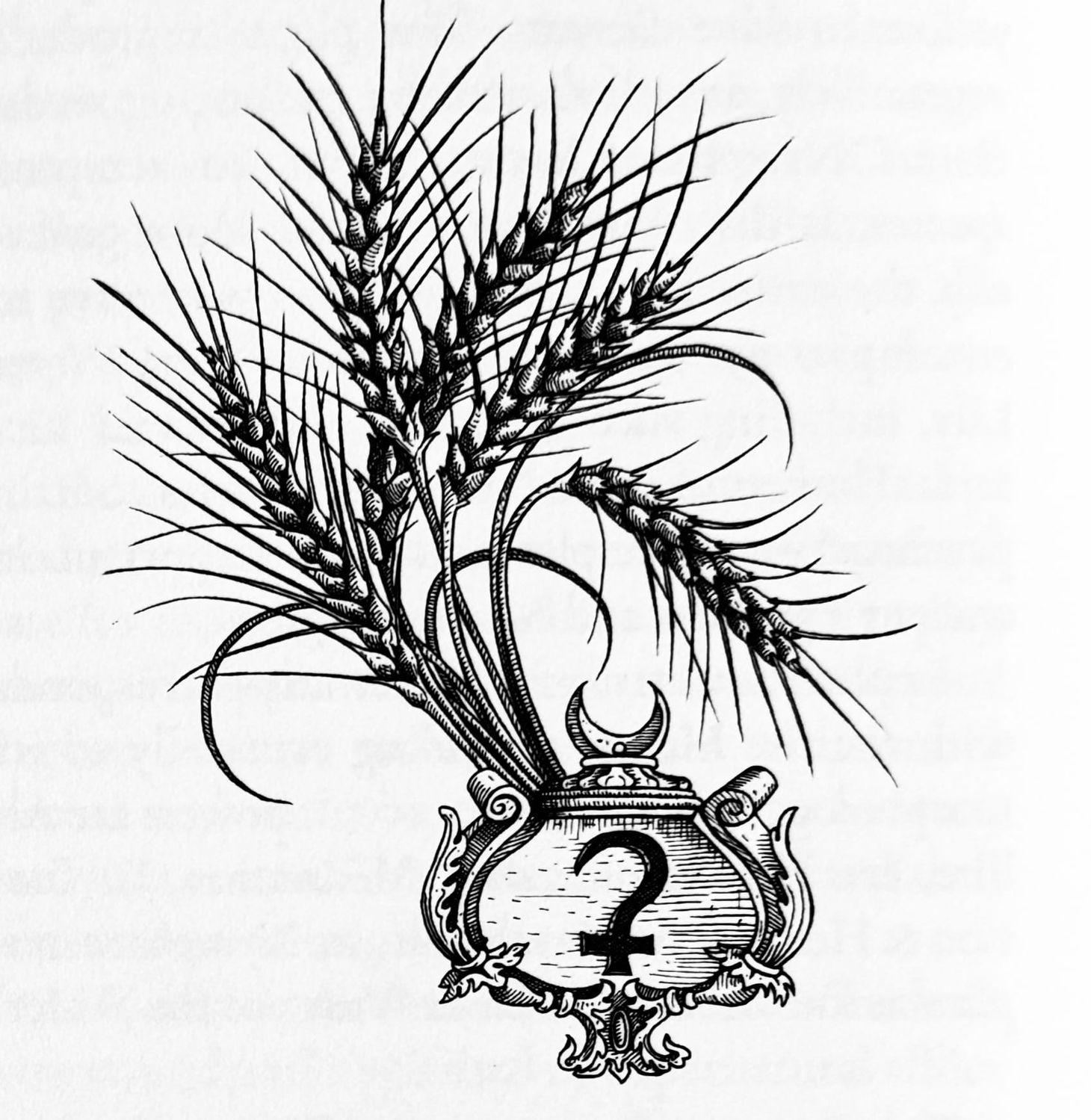
While I was in California for the past few weeks (a trip I plan to write about here in more detail soon), I stumbled upon a copy of Daniel Schulke's The Green Mysteries on a friend's bookshelf. The massive and fascinating (to me, at least) tome is a modern "occult herbarium," a lexicon of the spiritual, magical, and occult properties of plants. I was particularly (naturally) intrigued by the book's entry for wheat:
The oldest cereal remains generally conforming to the hexaploid Wheat of the modern era were found in the Çatalhöyük complex in Anatolia, dating to about 6400 BCE. If we consider domestication of the ancestral Einkorn, the timeline is pushed back at least a thousand years earlier. Remains of high-gluten Wheat varieties, essential for yeasted breads, have been located in archaeological sites dating to 1350 BCE.
Its planetary resonance it is linked with both Venus [and] Jupiter. Its occult properties are Fertility, Healing, Commerce, Wealth and Funerary power. Where intersection with classical deities is concerned, it is aligned with such goddesses as Demeter and Ceres, and those ancient grain-giving divinities that preceded them. In addition to its aspects of sexuality and fertility, it is connected with Immortality, and the mystery of Resurrection[...]
In Pomerania, the first sheaves of Wheat from the harvest were laid upon a cross to prevent their theft by witches familiars. Bunched Wheat stalks, known as trigo, are valued for their protective power in Spanish folk magic, and are used against the Evil Eye.
It is intimately connective with the human incarnative cycle, both embodying and empowering the force of Life. Wheat-corns were at one time showered over newly-married couples to ensure a happy and fertile union; in Syrian traditions, boiled wheat is served as a funeral meal, augmented with spices, walnuts, almonds, hazel-nuts, walnuts, or pine-kernels. When eaten by the mourners, they proclaim "May God bless him for whom we eat this now."[...]
A dream of harvesting ripe Wheat kernels was aid to portend success in business undertakings. If the kernels are green, success will be sure, but slow in coming. If green Rye-corns suddenly ripen, an unexpected inheritance is foretold. If the corn is blighted or rots on the stalk, this foretells significant loss in legal or business matters. If weevils, rats, or other vermin scamper among the ripe corns, your success will be followed by theft or heavy taxation of some kind. A burning sheaf is an adverse omen, signifying suffering, mortality, and death.
Later, the text discusses the use of wheat in ancient divination practices:
Alectryomancy is divination by grains of Wheat. Cicero, in De Divinatione, relays: "When Midas, King of Phrygia, was an infant, some ants crammed some grains of Wheat into his mouth while he was sleeping." From this, it was predicted he would later amass large amounts of gold. A classic method of alectryomancy involved drawing a circle on the ground, then dividing up equal portions of this circle for each letter of the alphabet. Each lettered section was sprinkled with grain, and a cock was released so that it might proceed [to] browse. Thus was a message pecked out, with new grains swiftly added to replace those eaten.
As it turns out, while the practice of alectryomancy did involve the use of grains of wheat, the word actually refers to the rooster, not the grains ("alectryon" is Greek for rooster). There is in fact a form of divination that involves grain primarily, however—aleuromancy. ("Aleuron" is Greek for flour, and it's where the English term "aleurone layer"—the nutrient- and enzyme-rich layer in a grain located just beneath the bran—comes from.)
Here is the Wikipedia entry on aleuromancy:
Divination with flour is attested in cuneiform tablets from the 2nd millennium BCE. Flour was poured out in small heaps and the interpretation was based on the observation of their shapes and orientation.
In its original form, slips of paper containing words of warning would be baked inside of cakes or cookies, which would then be distributed to those wishing their fortunes to be told. Similarly, the Greeks would bake slips of paper with sentences on them inside of balls of flour, mix the balls nine times, and distribute them. Modern fortune cookies are a variant on these forms of divination.
Another form of aleuromancy consisted of interpreting patterns of flour left in a bowl after a flour and water slurry had been mixed in it and poured away.
Finding this book was serendipitous, because I've been meaning to share something about aleuromancy for a while here. Recently my friend Jennifer Joan Billock, aka The Kitchen Witch, offered to do a "bread divination" for four lucky Wordloaf paid subscribers:
Have you ever had your fortune told with bread? Now’s your chance! I’m a divination expert, the world’s only professional cheese fortune teller, the official chocomancer for the NFL and Snickers, and now, Wordloaf’s resident bread-reader.
A few words exist for the practice of divination with bread: crithomancy, alphitomancy, and aleuromancy. The first two are related to breads made from barley, and aleuromancy is specifically about using flour of any type. We’ve also used bread throughout history by hiding trinkets inside a loaf to divine who is going to have good luck—think Ireland’s barmbrack and Mardi Gras king cakes. I think, though, we can make a new word for telling a fortune using any bread at all. Maybe yeastomancy? Wordloafination? I do divination with bread (and pastries, and baked goods of all types) by looking at the surface of your loaf and analyzing it similarly to how someone would read tea leaves.
Want to try it? All you Wordloaf paid subscribers have a chance to get your fortune told using bread, by me. Send me an email to the address below that includes a picture of any bread product you want (unwrapped please!), with the subject line “Wordloaf Bread Reading.” Then I’ll pick four of you at random to get the reading, which will show up in a future Wordloaf post, plus marked up images to point out what I saw. You can choose whichever bread product you’d like, and you can manipulate it in any way you like (leave it whole, bite it, tear it, soak it in water and reform it, whatever)—as long as there’s a surface for me to examine.
Ready? Let’s have some witchy (and bready) fun!
Those of you interested in having your breads read, find Jen's email address below the fold. For the rest of you, stay tuned for the future post where all shall be revealed.
—Andrew
This content is for Paid Members
Unlock full access to wordloaf and see the entire library of members-only content.
SubscribeAlready have an account? Log in